The Ghost Knew Her Grandmother's Name: Families Who Carry Their Hauntings From House to House
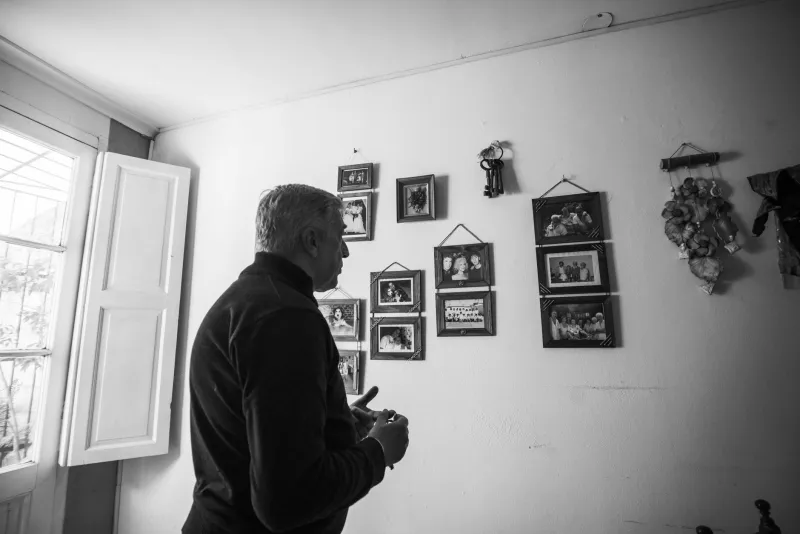
Sarah didn't think much of it the first time her daughter mentioned the woman in the hallway. Kids have imaginary friends. It's normal. But when her seven-year-old described the woman's dress in detail — a style Sarah recognized from photographs of her late grandmother — and then repeated a nickname only that grandmother had ever used for Sarah as a child, the explanation of "imaginary friend" stopped feeling adequate.
Sarah's family had moved twice in the past four years. The woman in the hallway had shown up in all three houses.
This kind of story — unnerving, specific, resistant to easy explanation — turns up more often than most people realize. And when paranormal researchers start mapping the cases, a pattern emerges that challenges one of the most basic assumptions in the field: that hauntings are fundamentally about place.
What if some of them are about family?
Rethinking the Location-Based Model
The dominant framework for understanding hauntings treats them as essentially geographic. A traumatic death occurs in a location. Energy — emotional, electromagnetic, or something we don't have a clean word for yet — gets imprinted on the physical space. People who enter that space later experience residual effects of that imprint.
It's a compelling model, and it explains a lot of cases well. But it struggles badly with a specific subset of hauntings: the ones that move.
Researchers who specialize in what some are calling relational hauntings — paranormal attachments centered on people rather than places — describe cases where families experience identical phenomena across completely different homes. Same apparitions. Same sounds. Same behavioral patterns from the entity. The house changes; the haunting doesn't.
In some documented cases, the activity actually intensifies after a move, as if the relocation itself agitated whatever was attached to the family.
Can a Ghost Recognize a Bloodline?
This is where things get genuinely strange, and where the research community is divided.
One theory holds that spirits of deceased relatives maintain some form of awareness of their living descendants — that the bond formed in life doesn't fully sever at death. Under this model, a grandmother's ghost isn't haunting a house. She's haunting her family. The house is just where she finds them.
The specificity of some reported experiences makes this hard to dismiss outright. Cases where an entity demonstrates knowledge — of family names, of private details, of events that occurred after the spirit's death — suggest something more than a simple location imprint. An imprint doesn't learn. An imprint doesn't update.
But there's a competing theory that's equally unsettling in its own way: that it's not the ghost following the family, but the family's trauma creating the conditions for paranormal activity wherever they go.
Ancestral Trauma and the Haunted Bloodline
The concept of generational or ancestral trauma has gained significant traction in psychology over the past two decades. Research suggests that severe traumatic experiences can leave measurable marks on gene expression — markers that are passed down to children and grandchildren who never experienced the original trauma firsthand.
Some paranormal researchers are asking whether this biological inheritance might also carry a kind of supernatural vulnerability. If trauma reshapes the nervous system in ways that persist across generations, could it also reshape a family's relationship to paranormal phenomena?
The anecdotal evidence is striking. Families with histories of documented hauntings frequently show patterns where the activity isn't random — it clusters around specific lineages within the family. A grandmother, her daughter, her granddaughter. The male line of the family experiences nothing. Or the haunting specifically targets the firstborn of each generation. The patterns, when they exist, are too consistent to feel coincidental.
Some investigators have begun treating ancestral research as a core part of their case intake process. Before they ever set foot in a client's home, they're asking about grandparents. About deaths in the family. About stories that got passed down or deliberately suppressed.
What they find, again and again, is that the haunting rarely begins with the current generation.
The Cases That Changed How Researchers Think
Without getting into identifying details — these are real families, and their privacy matters — there are several cases in the paranormal research literature that have shifted thinking on this topic significantly.
One frequently cited case involves a family in the Pacific Northwest that experienced escalating paranormal activity through four home purchases over eleven years. Each move was motivated partly by the activity becoming unbearable. Each new home showed no prior history of reported hauntings. Within weeks of each move, the phenomena resumed. Investigators who worked the case eventually traced a consistent detail — a specific auditory phenomenon, a rhythmic knocking in patterns of three — back through family testimony to a great-great-grandmother who died under violent circumstances in the early 1900s.
Another case, documented by researchers in the Midwest, involved an apparition that appeared to multiple family members across two generations and two states. The apparition was consistently described as a young man in period clothing. A genealogical investigation eventually identified a likely match: a family member who died young and whose death had been, for reasons unclear, essentially erased from family records. The family had never spoken of him. The apparition, researchers noted, seemed to be doing something about that.
What Families Can Actually Do
If relational hauntings are real — and the evidence is compelling enough that dismissing them entirely seems intellectually dishonest — then the standard advice for dealing with a haunting needs a serious update.
Clearing a house, blessing a space, smudging the corners — these approaches treat the location as the problem. If the attachment is to the family, not the building, those interventions might provide temporary relief at best. You're treating the symptom.
Researchers working in this area increasingly recommend a different approach: genealogical investigation combined with what some call acknowledgment work. The theory is that many relational hauntings involve unresolved family history — deaths that weren't mourned properly, stories that were buried, family members whose existence was erased. Bringing those histories to light, acknowledging them explicitly within the family, sometimes appears to reduce or eliminate the activity.
Whether that's because it satisfies whatever the spirit needed, or because it resolves the ancestral trauma that was generating the vulnerability in the first place, nobody can say for certain.
But for families like Sarah's, who have run out of houses to move to, it might be worth starting with the family tree before calling anyone with an EMF detector.
Some hauntings, it turns out, you can't move away from. You can only move through them.