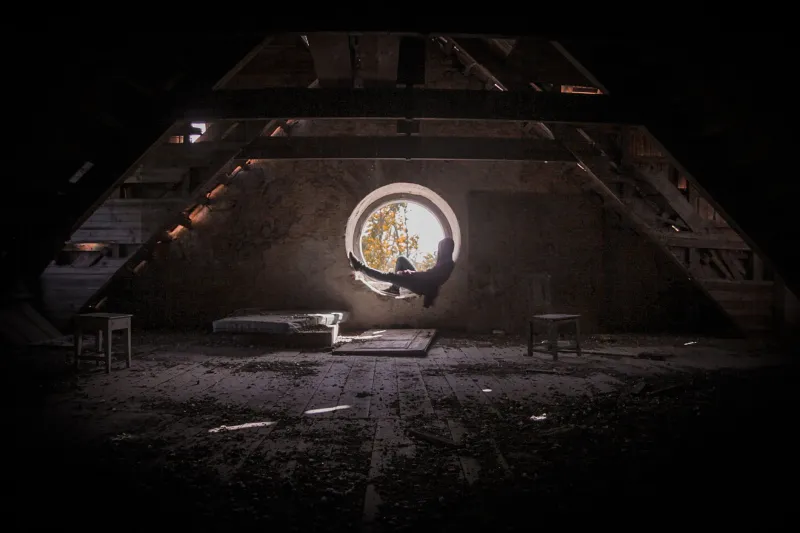
Alexa, Are You Alone in There? How Smart Home Tech May Be Rolling Out the Welcome Mat for Poltergeists
You've probably laughed it off before. Your Google Nest suddenly starts playing music nobody requested. Your Philips Hue lights pulse in the middle of the night like something out of a horror movie. Your Ring doorbell captures a shadow on the front porch — but nobody's there. Easy enough to blame on a glitchy firmware update, right?
Maybe. But a growing number of paranormal investigators across the U.S. are starting to ask a different kind of question: What if your smart home isn't malfunctioning? What if something else entirely is doing the driving?
The Poltergeist Problem Gets a Tech Upgrade
Poltergeist activity — the classic slamming doors, flying objects, unexplained knocking — has been documented for centuries. The word itself comes from the German for "noisy ghost," and reports of it stretch back well before anyone had a Wi-Fi router. But investigators are noticing a pattern shift in the kinds of cases they're getting called in on.
"Ten years ago, people called us because their grandmother's rocking chair was moving on its own," says Marcus Delray, a field investigator with a paranormal research group based out of Nashville, Tennessee. "Now half our cases involve smart devices doing things they absolutely shouldn't be doing — and when we sweep the space, the EMF readings are off the charts."
EMF, or electromagnetic field readings, have long been a staple tool in paranormal investigation. The working theory — still debated, still fascinating — is that paranormal entities either generate electromagnetic energy or are drawn to environments where it's already concentrated. And here's the uncomfortable truth about your modern smart home: it is, essentially, an electromagnetic field generator running 24 hours a day.
Your House Is Basically a Giant Antenna Now
Think about what a fully connected home looks like in 2024. You've got a Wi-Fi router pumping out signals. A smart thermostat. Voice-activated speakers in multiple rooms. Smart plugs. A video doorbell. Maybe a smart TV, a connected security system, and a handful of smart bulbs. Each of these devices communicates constantly — bouncing signals off walls, floors, and ceilings in an endless invisible chatter.
Dr. Lena Forsythe, an independent researcher who studies the intersection of electromagnetic environments and reported anomalous phenomena, puts it bluntly: "We've essentially transformed the average American living room into a low-level EMF soup. Whether or not you believe in the paranormal, that's a genuinely new environmental variable that didn't exist at this scale even fifteen years ago."
She's careful to stay neutral on whether that attracts entities outright, but she points out that the timing is hard to ignore. Reports of poltergeist-style activity — specifically involving electronic interference — have climbed steadily alongside smart home adoption rates. Correlation isn't causation, sure. But it's the kind of thing that makes a paranormal investigator sit up straighter.
When the Devices Talk Back
Some of the most unsettling cases involve voice-activated assistants. There's a well-documented quirk with devices like Alexa and Google Home where they occasionally respond to sounds that weren't intended as commands — a phenomenon Amazon officially calls a "false wake." Totally explainable. Totally normal.
Except investigators like Delray have walked into homes where Alexa was responding to... nothing. No ambient noise. No television. No kids in the room. Just silence, and then the device lighting up and speaking.
"We had one case in suburban Ohio where the family's Echo Dot would activate every night between 2 and 3 a.m.," he recalls. "Amazon's own logs showed no audio trigger. The device was just waking up. And every single time it happened, the family's youngest kid — a twelve-year-old — was home."
That last detail isn't a coincidence to most paranormal researchers. Poltergeist activity has historically been linked to adolescents, particularly those going through emotionally turbulent periods. The theory — explored thoroughly in parapsychology circles — is that young people can unconsciously generate or amplify psychokinetic energy. Add a house full of electromagnetically active devices to that mix, and some investigators believe you're essentially creating a paranormal amplifier.
Smart Lights and the 3 A.M. Problem
Smart lighting systems deserve their own paragraph here, because they show up in case reports with almost suspicious regularity. Investigators have documented countless instances of smart bulbs dimming, brightening, or changing color at odd hours — even when automation schedules are completely disabled and the app shows no activity.
One theory floating around in investigator communities is that certain paranormal entities interact most easily with devices that operate on lower, more variable power draws — exactly the kind of fluctuating current a smart bulb uses compared to a traditional incandescent. Whether that's science or speculation depends heavily on who you ask, but the reports are consistent enough that several investigators now include smart lighting behavior as a formal data point in their case assessments.
"If the lights are doing weird stuff and the EMF spikes line up with it, that's not something I'm willing to write off as a bug," says paranormal tech specialist Gina Ruiz, who consults on investigations across the Pacific Northwest. "That's a data point."
So What Do You Actually Do About It?
Here's where it gets practical. If you're living in a smart home and you're experiencing activity that feels like more than a software glitch, investigators generally recommend a few things.
First, document everything. Screenshot your device logs. Note the times. Write down who was home. Patterns matter enormously in these cases, and the more data you have, the clearer the picture becomes.
Second, consider a temporary tech audit. Unplug non-essential smart devices for a week or two and see if the activity changes. If your lights stop doing strange things the moment your smart hub goes offline, that's information worth having — even if it raises more questions than it answers.
Third, don't rule out mundane explanations, but don't dismiss your instincts either. A good paranormal investigator will always check for faulty wiring, signal interference, and app bugs before they start talking about entities. The goal is to eliminate the explainable so that what's left actually means something.
The Bigger Question Nobody's Ready to Answer
What we're really dealing with here is a collision between two worlds that weren't supposed to meet: consumer technology and the paranormal. Smart home companies aren't designing their products with ghosts in mind. Paranormal investigators weren't trained on network engineering. And yet here we are, in homes that hum with invisible energy around the clock, wondering why strange things keep happening after dark.
Maybe it's all firmware. Maybe it's all interference. Or maybe — just maybe — something out there figured out that your smart home just made itself a lot easier to reach.
Next time Alexa answers a question nobody asked, it might be worth wondering who, exactly, was doing the asking.