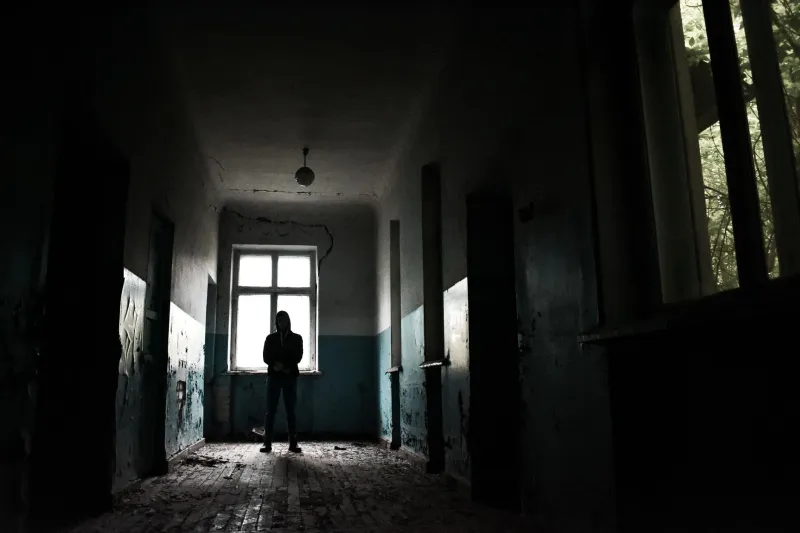
Talk to It: The Surprising Reason Ghosts Get More Active When You Stop Being Quiet
Picture the classic ghost hunt setup. A team of investigators fans out through a dark building, gadgets humming, everyone whispering or stone silent, waiting for something to happen. Hours pass. Maybe a meter twitches. Maybe it doesn't. The whole thing feels a little like sitting in a doctor's waiting room — lots of anticipation, not much payoff.
Now picture a different scenario. One investigator pulls up a chair in the middle of a supposedly haunted room, leans forward, and just starts talking. Not narrating to a camera. Not reciting some ritualistic prompt. Just talking — like they're having a conversation with someone who might or might not be listening.
That's when things tend to get weird.
Across the paranormal investigation community in the United States, researchers are reporting a consistent and genuinely puzzling pattern: active, conversational engagement with potential entities seems to dramatically increase the frequency and intensity of unexplained activity. It's being called the Paranormal Listening Effect, and whether you chalk it up to psychology, physics, or something that defies both, the data coming out of the field is hard to dismiss.
From Passive Monitoring to Active Dialogue
For most of paranormal investigation's modern history — think the post-Ghost Hunters era when the hobby exploded into mainstream American culture — the dominant methodology was essentially surveillance. Set up cameras. Deploy equipment. Observe. React.
The assumption baked into that approach was that paranormal phenomena existed on their own schedule and investigators were just there to document it. You didn't interact with a thunderstorm. You didn't ask a poltergeist to perform on command. You waited.
But a growing number of researchers started noticing something that didn't fit that model. When they accidentally broke protocol — when someone got frustrated and muttered something at the ceiling, or when a newer investigator nervously started narrating their own fear out loud — the equipment would spike. Doors would creak. Temperatures would shift. The sessions that felt most like conversations were producing the most compelling results.
This wasn't anecdotal for long. Teams started logging it deliberately, comparing sessions where they maintained silence against sessions where they used what's now commonly called "directed dialogue" — structured questioning aimed at whatever might be present. The difference in recorded anomalies, across multiple locations and multiple teams, was striking enough to make people rethink the whole passive model.
What the Questions Actually Do
Here's where it gets interesting, because there are at least two completely different explanations for why this works — and both of them are worth taking seriously.
The psychological explanation centers on the investigator, not the entity. When you ask a question and then go completely silent waiting for an answer, your brain shifts into a state of heightened sensory attention. You're not just passively present anymore — you're actively scanning. Subtle environmental changes that might have slipped past your awareness during passive monitoring suddenly register. A faint sound. A slight pressure change. A shadow that moves differently than the others.
This doesn't mean the experiences aren't real. It means the act of asking might be recalibrating the human instrument doing the detecting. And given that many serious investigators consider themselves part of the equipment — not just the operators of it — that's a meaningful distinction.
The supernatural explanation, the one that keeps paranormal researchers up at night in the best possible way, is more direct: entities respond to engagement because they're aware. Because they're listening. Because on some level, being acknowledged matters to whatever is left behind after death.
This idea shows up in documented cases from locations all over the country. At a former Civil War hospital in Virginia, investigators reported that EVP sessions yielded almost nothing until one researcher began addressing specific soldiers by name, asking about their experiences during the battle. The shift in audio activity was immediate and, frankly, difficult to explain away. Similar patterns have emerged at former prisons, old family homesteads, and — repeatedly — at locations where violent or traumatic deaths occurred.
The Documented Cases That Changed the Conversation
One of the most cited examples in investigative circles involves a private residence in rural Ohio that had been plagued by what the family described as a presence fixated on the youngest child. Standard monitoring over several visits produced almost nothing measurable. When a researcher finally sat in the child's room and began speaking directly — acknowledging the presence, expressing that it had been noticed, asking what it wanted — the session produced some of the clearest EVP recordings the team had ever captured.
What the recordings appeared to say is still debated. What isn't debated is that they weren't there before the conversation started.
Researchers who specialize in residual versus intelligent hauntings point to cases like this as evidence for the latter category. A residual haunting — essentially a psychic echo, an event replaying on a loop — wouldn't respond to questions. It can't. It's not aware of you. But an intelligent haunting, one involving an entity with some degree of consciousness and intent, might respond precisely because it's been waiting for someone to actually show up and engage.
The distinction matters enormously for how investigations are conducted. If you're dealing with residual energy, passive monitoring makes sense. If you're dealing with something aware, silence might be the least effective tool in your kit.
Why Engagement Might Amplify Presence
Some researchers are pushing further, suggesting that human engagement doesn't just detect paranormal activity — it might actively amplify it. The theory, loosely, is that conscious attention functions as a kind of energy source. When a person focuses intent and emotion toward a location or entity, they might be contributing something that the entity can use.
This tracks with older traditions around spiritual communication — the idea that rituals, prayers, and invocations work because they channel concentrated human intention. It also connects to research in parapsychology around phenomena like the Philip Experiment, where a group in Canada seemingly generated paranormal activity around a fictional character they collectively imagined into existence. The group's focused, emotionally engaged attention appeared to be doing something measurable.
If that framework holds, then an investigator sitting silently in a dark room is offering very little. But one who's fully present, emotionally engaged, and actively communicating might be providing exactly what an entity needs to make itself known.
What This Means for How We Hunt
The practical implications for paranormal investigation are significant. Teams that have adopted active dialogue protocols are reporting richer, more consistent results — not just in EVP, but in physical phenomena, equipment responses, and the kind of spontaneous occurrences that are hardest to explain away.
It also changes the emotional texture of an investigation. There's something fundamentally different about walking into a haunted space as a witness versus walking in as a participant. The former keeps you at arm's length. The latter means you're genuinely showing up — present, open, and willing to be heard.
Whether the thing on the other side of that conversation is a ghost, a residual consciousness, something stranger than either of those categories, or a projection of your own heightened awareness doesn't fully resolve the question of what's happening. What it does suggest is that showing up halfway — monitoring from a distance, waiting passively, treating the investigation like a nature documentary — might be the wrong approach entirely.
Some doors, it turns out, only open when you knock.
And some presences only speak when spoken to.