America's Vanishing Zones: The Geographic Hotspots Where People Simply Cease to Exist
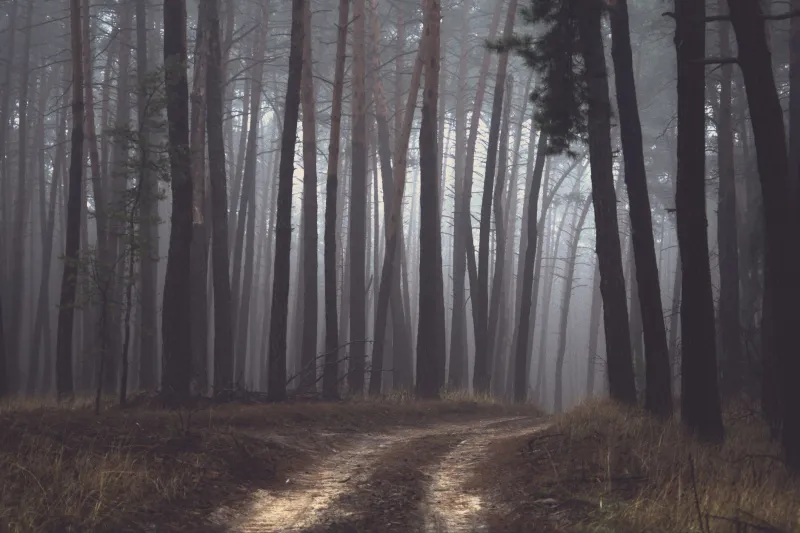
There's a particular kind of dread that settles in when a search party combs every inch of a trail, every hollow log, every creek bank — and finds absolutely nothing. No gear. No footprints leading out. No body. Just absence. Clean, total, impossible absence.
It happens more than most people realize. And here's the part that keeps researchers up at night: it keeps happening in the same places.
The Bennington Triangle: Vermont's Quiet Horror
Tucked into the southwestern corner of Vermont, the area surrounding Glastenbury Mountain doesn't look like anywhere sinister. It's beautiful, actually — dense forest, cold streams, the kind of landscape that ends up on fall foliage postcards. But between 1945 and 1950, five people vanished in this relatively small stretch of wilderness under circumstances that still haven't been explained.
Middlebury College student Paula Welden disappeared on a hiking trail in 1946 while witnesses watched her walk around a bend — and then she simply wasn't there anymore. Eight-year-old Paul Jepson vanished from a truck while his mother worked nearby. Frieda Langer fell into a stream, told her cousin she'd be right back after changing clothes, and was never seen alive again — until her body turned up months later in an area that had already been searched multiple times. Cause of death? Undetermined.
Local Abenaki tradition had long considered Glastenbury Mountain a cursed place, somewhere that four winds met and where the ground itself was considered dangerous. Paranormal researchers who've worked the area point to reports of strange lights, compass malfunctions, and an unusual electromagnetic signature in the soil. Whether that explains anything is another matter entirely.
Missing 411 and the Pattern Nobody Wanted to See
Former law enforcement officer and investigator David Paulides spent years combing through National Park Service records and stumbled onto something the agency wasn't exactly advertising: clusters of disappearances in specific geographic zones that defied conventional explanation. His ongoing Missing 411 research has documented hundreds of cases where people — often experienced outdoors people, often children, often individuals with dogs that also vanish — go missing under circumstances that don't add up.
The pattern Paulides identified isn't just about the numbers. It's about the details. Bodies found miles from where they went missing, often in terrain they couldn't have physically crossed. Victims found without shoes. Search dogs that refuse to track a scent, or that track it directly to a body of water with no indication the person entered. Cases where the weather turned severe immediately after someone disappeared, as if something wanted the trail washed clean.
National parks themselves present a unique investigative challenge. The NPS doesn't maintain a centralized database of missing persons cases — a fact Paulides found so strange that it became a central thread of his research. When you have to file individual FOIA requests park by park to get a picture of how many people have gone missing, the data gets fragmented in ways that make patterns hard to see. Unless, of course, you're specifically looking for them.
The Olympic Peninsula and the Pacific Northwest Clusters
Washington State's Olympic Peninsula sits at the intersection of several reported Missing 411 clusters. The terrain is brutal — old growth forest so thick that daylight barely penetrates the canopy, river systems that shift seasonally, and elevation changes that can disorient even seasoned hikers within minutes. But investigators who've studied the disappearances here note that many of the cases don't involve the kind of terrain-related accidents you'd expect.
Some paranormal researchers theorize that certain geographic zones — particularly those near granite formations, bodies of water, and areas with documented geomagnetic anomalies — may function as something like natural portals or zones of dimensional instability. It sounds extreme. But when you stack case after case where a person was seen one moment and simply wasn't the next, you start running out of conventional explanations.
Electromagnetic field (EMF) irregularities have been documented in several disappearance hotspots. Some investigators believe that intense, localized EMF fluctuations could theoretically cause disorientation, hallucinations, and altered states of consciousness — effects that could explain why someone might wander off a trail they knew well. Others go further, suggesting these zones might interact with human consciousness in ways science hasn't fully mapped yet.
What the Numbers Actually Say
It's worth being careful here, because the disappearance cluster phenomenon is easy to sensationalize and hard to verify. Survivorship bias plays a role — we remember the strange cases, not the thousands of people who got lost and were found. Geographic areas with more visitors will statistically have more disappearances. Remote wilderness is genuinely dangerous in ways that don't require the paranormal to explain.
But researchers who've done the granular work — cross-referencing visitor counts with disappearance rates, controlling for terrain difficulty, accounting for population density — still find anomalies that the statistical noise doesn't swallow. Certain zones consistently produce disappearances at rates that exceed what the variables should predict.
Paranormal investigators who've worked these areas in the field describe experiences that don't make it into official reports. Equipment failures in specific locations. A sudden, overwhelming sense of being watched or of needing to leave immediately. Sounds that don't match any known wildlife. One investigator who asked to remain unnamed described spending time near a documented cluster zone in the Appalachians and experiencing what she called "a gap" — a stretch of roughly forty minutes she couldn't account for, during which her recording equipment had captured nothing but static.
The Question Worth Asking
Maybe these zones are just geography doing what geography does — presenting conditions that are genuinely, statistically more dangerous. Maybe the clustering is partly a function of how we collect and report data. Maybe some of these cases have mundane explanations that got lost in the telling.
But the families of the missing don't get the luxury of maybe. And the investigators who've dedicated years to these clusters — who've stood in the specific coordinates where someone was last seen and felt something shift — aren't easily dismissed as people who want to believe.
The land remembers things. Whether it keeps them, or whether something else does, is the question that keeps this particular file open.