Why Ghosts Seem to Get Louder When the Leaves Start Falling
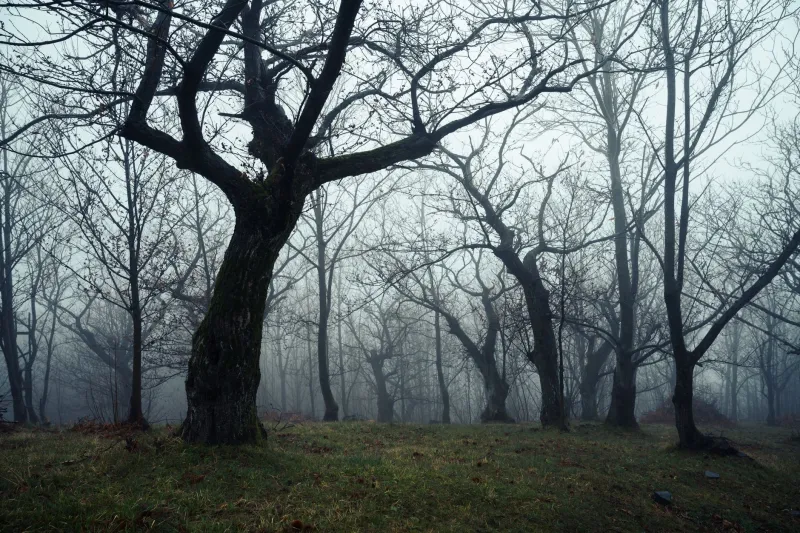
Every October, paranormal hotlines light up, investigation requests flood in, and suddenly everyone's neighbor has a ghost story. But is something genuinely supernatural shifting with the seasons, or are our brains just wired to expect things that go bump in the night when the days get shorter and the air gets cold?
The answer, depending on who you ask, is probably both — and that's what makes it genuinely fascinating.
The Numbers Don't Lie (But They Do Get Complicated)
If you dig into the data that paranormal research organizations have been quietly accumulating for decades, a pattern does emerge. Groups like the American Ghost Society and various regional investigation teams consistently report that call volume and formal investigation requests spike between September and February, with October and November sitting at the top of the pile by a significant margin.
Some researchers point to cultural scaffolding as the obvious explanation — Halloween primes the pump, ghost tours run all fall, and horror movies dominate streaming queues. Fair enough. But the spike doesn't neatly drop off on November 1st. Reports stay elevated well into the winter months, long after the decorations come down and the candy bowls are empty.
That sustained pattern is what keeps serious investigators from writing the whole thing off as seasonal suggestion.
What Environmental Changes Actually Do to a House
Here's where things get interesting from a purely physical standpoint. As temperatures drop across most of the US, homes go through a series of structural changes that can produce genuinely strange phenomena — the kind that would absolutely get flagged during a paranormal investigation.
Wood contracts. Pipes shift. Old houses that sat quietly all summer start groaning and ticking as the cold moves in. Drafts that were imperceptible in July become strong enough to move curtains, extinguish candles, and create cold spots in specific corners of a room — one of the most commonly reported signs of a haunting.
Then there's the heating system. Forced-air furnaces and old radiators can push infrasound through a structure — low-frequency vibrations below the threshold of human hearing that have been linked in laboratory settings to feelings of unease, the sense of being watched, and even visual disturbances. We've covered infrasound before on this site, and the research is legitimately unsettling. The point is, your furnace kicking on for the first time in months might be doing more to your nervous system than just warming the room.
Basements and crawlspaces also tend to off-gas more in fall as the ground cools and pressure changes. Certain mold strains and naturally occurring gases like carbon monoxide or radon can cause cognitive effects — confusion, anxiety, auditory hallucinations — that map almost perfectly onto classic haunting experiences.
None of that means the activity isn't real. It means the environment is actively conspiring to make your house feel haunted.
The Psychological Season
Dr. Christopher French, a psychologist who has spent years studying anomalous experiences, has argued that expectation is one of the most powerful forces in paranormal perception. When people expect to encounter something unusual, they're significantly more likely to interpret ambiguous stimuli — a creak, a shadow, a cold draft — as evidence of something supernatural.
And in the US, fall is drenched in supernatural expectation. From the moment pumpkin spice hits the shelves, the cultural narrative shifts toward the uncanny. Ghost tours sell out in cities like Savannah, New Orleans, and Salem. True crime podcasts see listenership spikes. Even mainstream media starts running haunted house segments and paranormal documentaries.
We are, collectively, primed.
But here's what the pure skeptics tend to gloss over: that priming doesn't fully explain the reports that come in from people who weren't thinking about ghosts at all. The homeowner in rural Ohio who calls a paranormal team in January because something has been moving through her hallway for three weeks. The family in suburban Minnesota who starts finding doors open that they definitely closed. These aren't people who just watched a scary movie.
What Veteran Investigators Actually Think
Talk to investigators who've been doing this for more than a decade and most of them have developed a nuanced view that resists easy categorization. They've seen enough cases where the "haunting" turned out to be a drafty window or a carbon monoxide leak to stay humble about immediate conclusions. But they've also documented enough genuinely unexplained incidents — EVPs that don't match any environmental source, temperature drops that don't correlate with HVAC activity, physical objects moving in controlled conditions — to stay curious.
The seasonal pattern, in their experience, tends to reflect a mix of factors. More time spent indoors means more time noticing the house. Longer nights mean more encounters in low-light conditions, where the human brain is already working harder to fill in visual gaps. And yes, the genuine structural and environmental changes in a home during cold months create more anomalous stimuli to investigate.
But several investigators have also noted something harder to quantify: that certain locations they've monitored over multiple years do seem to produce more compelling evidence in fall and winter. Not just more reports — more evidence. Better EVP sessions. More consistent equipment responses. Whether that's a function of atmospheric conditions affecting how sound and electromagnetic fields behave, or something else entirely, remains an open question.
The Thin Veil Theory
It's worth noting that the idea of fall as a spiritually porous time of year isn't a modern invention or a Halloween marketing scheme. Across cultures and centuries — from the Celtic Samhain to the Mexican Día de los Muertos to various Asian ghost festivals — the transition from harvest to winter has been understood as a period when the boundary between the living and the dead becomes less stable.
Whether you take that as metaphor or literal belief, it's striking that so many independent traditions landed on the same seasonal window. That kind of cross-cultural convergence doesn't prove anything, but it does suggest the human experience of fall as a haunted season runs deeper than any single cultural tradition.
So Does Activity Actually Increase?
Honestly? Probably yes and no, depending on how you define "activity."
Reports increase — that's documented. Environmental conditions that can produce haunting-adjacent experiences increase — that's physics. Psychological susceptibility to supernatural interpretation increases — that's neuroscience. And if you believe, as many investigators do, that certain forms of paranormal phenomena are influenced by human emotional states and collective attention, then the sheer volume of people focusing on the supernatural during fall months might itself be a contributing factor.
What doesn't hold up is the idea that it's all suggestion and seasonal psychology. The data is messier than that, and the unexplained cases don't conveniently cluster around Halloween.
Maybe the most honest answer is that fall strips away some of the noise — the long bright days, the open windows, the outdoor distractions — and leaves us alone with our houses in the dark. And in that quiet, whatever was already there gets a little harder to ignore.
Whether that's a ghost or just the house settling is, as always, something you'll have to decide for yourself.