City Spirits vs. Country Ghosts: Why Where You Live Shapes What Haunts You

If you've ever lived in a cramped city apartment and felt like something was watching you, you're not alone. But here's what most people don't realize: that experience is probably pretty different from what someone feels standing alone in a century-old farmhouse in rural Tennessee at two in the morning. Paranormal researchers who work across both environments say the gap between urban and rural hauntings isn't just about setting — it goes deeper than that, touching on the very nature of how supernatural activity seems to express itself.
So what's actually going on? Are spirits adapting to their surroundings like some kind of supernatural chameleon? Or are certain types of entities simply drawn to specific landscapes? Investigators who've logged hours in both skyscrapers and cornfields have some genuinely fascinating — and occasionally unsettling — thoughts on the matter.
The Urban Haunting: Compressed, Chaotic, and Crowded
In a city like Chicago, New York, or Los Angeles, paranormal activity tends to come in short, sharp bursts. Investigators describe urban encounters as almost frantic — quick apparitions, sudden drops in temperature, electronics behaving erratically for a few minutes before everything goes back to normal. The energy feels compressed, like the haunting itself is working within the same tight spatial constraints as the living people around it.
That makes a certain kind of sense when you think about it. High-rise apartments sit on top of layers of history — literally. The ground beneath a 40-story building in downtown Boston might hold the memory of a colonial-era cemetery, a 19th-century tenement fire, and a mid-century construction accident, all stacked on top of each other. Paranormal researcher and field investigator Dana Kellstrom, who has worked cases in both New York City and rural Vermont, puts it this way: "Urban environments are like a pressure cooker. There's so much residual energy packed into a small space that manifestations tend to be intense but brief. The ghost doesn't have room to breathe, so to speak."
There's also the matter of interference. Cities are electromagnetic nightmares — cell signals, Wi-Fi networks, subway systems, electrical grids all create a constant background hum that can muddy paranormal readings. EVP sessions in urban settings often pick up far more noise contamination. Some investigators argue this actually suppresses certain types of activity, while others believe it creates the conditions for a different kind of haunting altogether — one that piggybacks on existing electrical infrastructure rather than fighting against it.
Out in the Open: How Rural Hauntings Breathe Differently
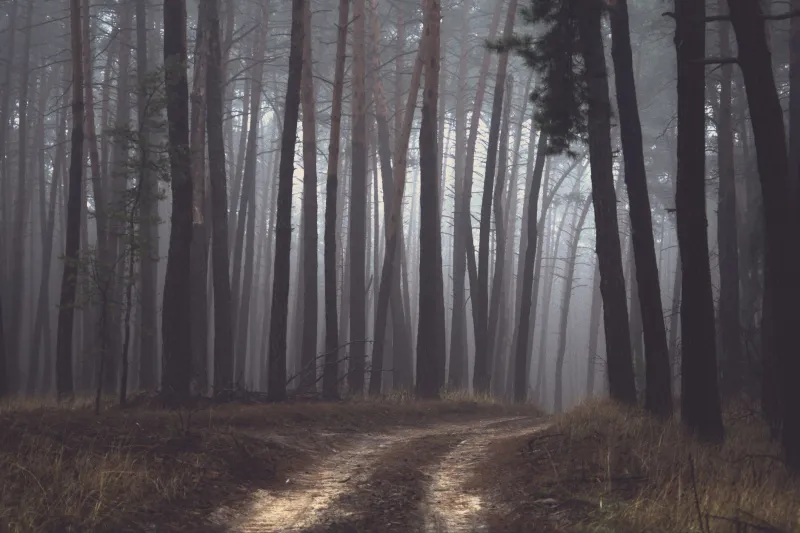
Step outside the city and the paranormal landscape shifts dramatically. Rural hauntings — the kind that unfold across old farmsteads in the Midwest, abandoned plantation homes in the South, or forgotten mining communities in Appalachia — tend to operate on a completely different timeline. Investigators describe these encounters as slow-building and immersive. The activity doesn't spike and vanish; it lingers.
Robert Vance, a paranormal researcher based in western Kentucky who specializes in rural property investigations, says the difference is almost atmospheric. "In the country, there's nothing competing with the haunting. No traffic noise, no Wi-Fi saturation, no neighbors above and below you. Whatever is present in that space has the full stage, and it knows it." He's documented cases on working farms where the same apparition has been reported by multiple generations of the same family — something that rarely happens in urban environments where turnover is constant and buildings change hands every few years.
There's also a geographic memory element at play. Rural land holds history differently than city land does. When a farmhouse in rural Georgia has been sitting on the same property since 1847, that soil has absorbed generations of births, deaths, labor, and grief. The land itself becomes part of the haunting in a way that a poured-concrete foundation in a modern apartment complex simply can't replicate. Many investigators believe this is why rural hauntings so often feel tied to the land rather than the structure — the entity isn't haunting the house, it's haunting the place.
Do Spirits Actually Adapt?
Here's where it gets genuinely weird. A growing number of paranormal researchers are entertaining the idea that spirits — or whatever energy underlies these experiences — may actually adjust their behavior based on environmental cues. It sounds like a stretch, but the pattern of evidence is hard to ignore.
In urban investigations, activity frequently involves technology: phones glitching, smart speakers responding to nothing, security cameras catching unexplained shadows. In rural investigations, the manifestations tend to be more elemental — unexplained sounds in the walls, the smell of people or things long gone, physical sensations like being touched or having your temperature suddenly plummet. Some researchers theorize that an entity interacts with the environment it finds available to it. Give it a smart home device and it'll use that. Give it a creaking floorboard and an empty barn and it'll use that instead.
Kellstrom isn't entirely sold on the adaptation theory but acknowledges the pattern is real. "I think it's less about adaptation and more about what the location attracts," she says. "Residual hauntings — the kind that are basically emotional echoes — tend to cluster in rural areas because those environments preserve memory better. Intelligent hauntings, the ones that actually interact with you, show up everywhere, but in cities they have more tools to work with."
What This Means for Investigators
Practically speaking, these regional differences have started to change how serious paranormal investigators approach their cases. Urban investigations now often include protocols specifically designed for high-interference environments — shielded equipment, multiple redundant recording systems, and careful attention to baseline EMF readings before any investigation begins. Rural investigations, meanwhile, increasingly involve extended stays rather than single overnight visits, because the activity simply takes longer to reveal itself.
There's also a psychological component that investigators are starting to account for. Urban witnesses tend to report their experiences in fragmented, almost apologetic terms — "I know this sounds crazy, but..." Rural witnesses often describe the same phenomena with a matter-of-fact certainty, as if the paranormal is simply part of the landscape they've always lived in. Whether that's cultural, psychological, or something else entirely is its own rabbit hole.
The Bigger Question
What all of this points to is something the paranormal research community has been circling for years without quite landing on: the environment doesn't just host supernatural activity. It might actually shape it. The geography, the history, the electromagnetic conditions, the density of human experience layered into a place over time — all of it appears to influence what gets reported, how it manifests, and how long it sticks around.
Whether you're lying awake in a Brooklyn walk-up listening to footsteps that don't belong to your upstairs neighbor, or standing on a frost-covered field in rural Nebraska watching a light move between the tree line and the barn, something is happening. It just looks different depending on where you're standing — and that might be the most fascinating paranormal discovery nobody's talking about loudly enough.