Mirror, Mirror: Paranormal Investigators Who Came Face to Face With Themselves
Abraham Lincoln reportedly saw his own double in a mirror shortly before his assassination — two faces, one slightly paler than the other, staring back at him from the glass. His wife, Mary Todd, took it as a death omen. History, of course, didn't argue with her.
The doppelgänger — literally "double walker" in German — is one of those concepts that exists in nearly every human culture that has ever put pen to paper. And while most people encounter the idea in folklore or horror fiction, there's a surprisingly consistent thread of reported real-world experiences that refuses to be filed away neatly.
What makes the paranormal investigation community particularly interesting in this context is simple: these are people trained to observe, document, and question. When they say they saw something, they've usually already ruled out the easy explanations.
What History Actually Recorded
Before we get into the contemporary accounts, it's worth grounding this in how old and how widespread the doppelgänger phenomenon actually is. Ancient Egyptian belief held that every person had a ka — a spiritual double that existed alongside the physical body. Norse mythology described the vardøger, a ghostly precursor that would arrive at a location before the actual person, doing things the person would later do. In German Romantic literature, encountering your double was considered a harbinger of death — your soul preparing to split from your body.
Johann Wolfgang von Goethe wrote about meeting his own double on a road. Percy Bysshe Shelley reportedly encountered his shortly before he drowned. Queen Elizabeth I is said to have seen her double lying on her bed in the days before her death.
The consistent thread across cultures and centuries isn't just the visual experience — it's the feeling that accompanies it. Witnesses almost universally describe a sense of profound wrongness, a cold that isn't temperature-based, and an instinctive understanding that what they're seeing is not a reflection or a coincidence.
When Investigators Become the Investigated
Paranormal investigators occupy an unusual position. They spend significant time in locations where the boundary between the physical and whatever lies beyond it is considered thin. Whether or not you believe in that framework, it creates conditions — high EMF environments, infrasound, psychological priming, genuine stress — that some researchers think may make certain experiences more likely.
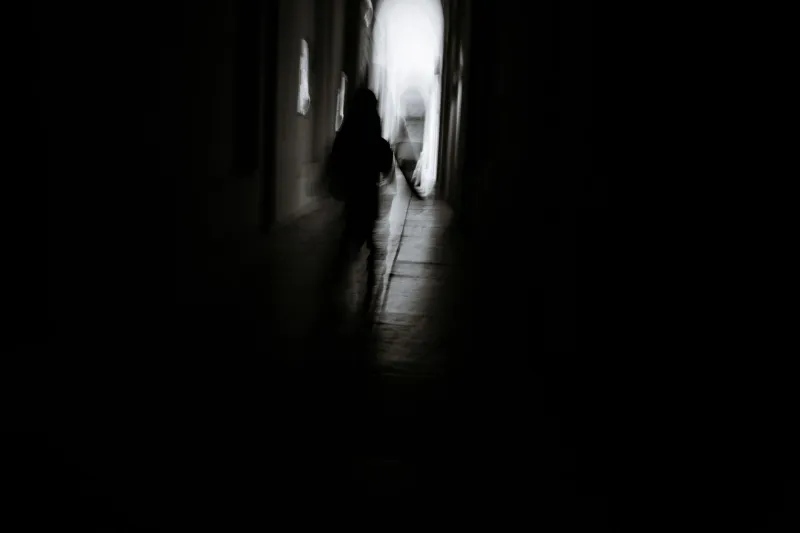
One investigator based in the Midwest, who has been doing field work for over a decade, describes an experience during a residential investigation in Ohio. She had stepped into a hallway to review audio footage on her equipment when she saw a woman at the far end of the hall, facing away from her. Same height. Same hair. Same jacket she was wearing that night. When she called out, the figure turned — and she describes the face as her own, but "like a photograph that had been left in the sun too long. The colors were slightly off."
She ran the footage from the camera she'd set up in that hallway. The camera showed her standing at one end of the hall. Nothing else was there.
Another investigator, working a reportedly active location in rural Pennsylvania, describes a more disorienting version: his team members saw him in two places simultaneously. He was in the basement reviewing equipment while two other team members, separately, reported seeing him walk through the upstairs kitchen. When they compared notes at the end of the night, all three were shaken. He had never left the basement.
The Theories: From Psychology to Interdimensional Physics
Explaining doppelgängers is genuinely complicated because the phenomenon seems to resist a single clean framework.
On the psychological side, researchers have pointed to a condition called autoscopy — a neurological event where a person perceives a double of themselves, usually attributed to disruptions in the temporoparietal junction of the brain. It's real, it's documented, and it can produce vivid, convincing visual experiences. Infrasound — low-frequency sound waves produced by certain building structures, HVAC systems, or geological features — has been shown to cause feelings of unease, visual disturbances, and in some cases, apparitions.
But autoscopy and infrasound don't easily explain cases where other people see your double while you're somewhere else. That's the part that gets uncomfortable for conventional explanations.
Some paranormal researchers operate within a framework that treats consciousness as something that isn't fully contained by the physical body — a perspective that has more overlap with certain areas of quantum physics than most people expect. From this angle, a doppelgänger might represent a kind of "bleed" between parallel states of existence, a version of you from an adjacent reality briefly occupying the same space as this one.
Others take a more entity-based approach: that certain intelligent non-human presences are capable of mimicking human appearance, and that they may specifically target people who are attuned to their environment — like investigators who've trained themselves to notice subtle shifts in energy and atmosphere. The idea being that something mimics what you'd be least likely to question.
And then there's the oldest interpretation: that seeing your double is a warning. Not a supernatural punishment, but a signal — your psyche or something connected to it sending up a flare about danger ahead.
What Investigators Actually Do With This
Most experienced paranormal researchers who've had doppelgänger encounters describe an immediate protocol shift. The investigation pauses. Everyone's location gets verbally confirmed. Footage is reviewed in real time rather than later. It's treated the same way you'd treat a fire alarm — you don't assume it's a drill.
Some investigators have started incorporating specific questions into their pre-investigation setup: documenting everyone's exact clothing, establishing communication check-ins at regular intervals, and flagging any location where team members report seeing each other in places they weren't. It's a way of creating a paper trail that can either validate or debunk a claim after the fact.
What's notable is that the investigators who take these experiences most seriously aren't the ones who arrived already believing. They're the ones who had something happen that their existing framework couldn't account for — and who decided that intellectual honesty required them to sit with the discomfort of not knowing.
The Face in the Hallway
Doppelgängers sit at an uncomfortable intersection. They're too psychological to be purely paranormal, too strange to be purely neurological, and too consistent across too many cultures and centuries to be written off as mass confusion.
If you're an investigator and you see your own face looking back at you from somewhere it shouldn't be — stay calm, verify your team's locations, and document everything. Whether what you're looking at is a glitch in your brain, a bleed from somewhere else, or something wearing your face for reasons you haven't figured out yet, the answer starts with the evidence you collect in that moment.
And maybe don't look away too fast. Sometimes the double blinks first.